The single family office software market has expanded significantly in recent years, with more platforms competing for the same mandates than at any previous point. For a UK or European single family office beginning or reviewing a software evaluation, the volume of options is not the challenge. The challenge is knowing which capabilities to prioritise and which vendor claims to scrutinise.
This comparison evaluates the leading platforms against the five requirements that matter most for a UK or European SFO: custodian connectivity breadth and quality, analytics depth, reporting flexibility, AI capability, and security architecture. These are not arbitrary criteria. They reflect the specific operating environment of a European single family office: a complex, multi-custodian portfolio with significant alternative investment allocations, managed by a lean team, held to the highest standard of data governance, and increasingly expected to deliver on-demand insight to a sophisticated family.
The five requirements that define the best platform for a UK or European SFO
Custodian connectivity determines what proportion of the portfolio the platform can aggregate automatically. For a UK or European SFO with relationships across private banks, custodians, and administrators across multiple jurisdictions, the breadth of direct institutional connections, and critically the quality of those connections as direct SFTP feeds rather than web scrapers, determines the true automation rate the platform delivers.
Analytics depth determines the quality of insight the platform can produce from that data. For an SFO with a complex, multi-asset mandate, performance measurement against configurable benchmarks, exposure analysis across all asset classes, liquidity monitoring, and institutional-grade risk analytics are not optional capabilities. They are the foundation of the investment team's ability to make informed decisions and present credible insight to the family.
Reporting flexibility determines whether the platform can produce reports that reflect the specific way the family holds and thinks about their wealth, rather than a generic template that requires manual workarounds for anything non-standard. For a European SFO with complex ownership structures across multiple jurisdictions, this is the capability that most commonly separates platforms that work well in practice from those that look right in a demonstration.
AI capability is increasingly a meaningful dimension of the evaluation, but the claims in this area require scrutiny. The AI capability that matters for an SFO is not a general-purpose assistant bolted onto the platform. It is an agent that operates directly on the office's own portfolio data, within the office's own permissions framework, producing reliable answers from a complete and current data environment.
Security architecture is the non-negotiable foundation. A platform holding the complete financial picture of a single family must provide physical data isolation, with the family's data held in a dedicated environment architecturally separate from any other organisation's data, supported by independently audited security certifications.
The platforms compared
Sesame One by Landytech
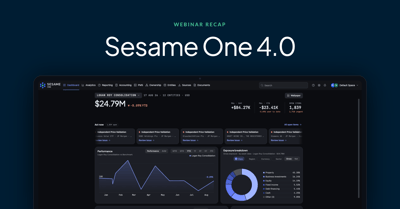
Sesame One is purpose-built for the complexity of single family office and institutional portfolio management. It is the platform that most directly addresses all five of the requirements defined above, and it does so with a depth of capability that reflects a specific investment in the UK and European SFO market.
On connectivity, Sesame One connects to 500+ custodians globally and 10,000+ banks through open banking for cash accounts, with all major connections delivered through direct SFTP or API feeds rather than web scraping. This is the broadest institutional connectivity in the market for UK and European family offices, and the quality of the connections, structured and validated at the point of delivery, means the data arriving into the platform is reliable rather than extracted. For the alternative investment data that does not arrive through automated feeds, Sesame One's Doc AI handles capital account statements, NAV letters, and LP reports automatically, extracting and validating data from unstructured documents without manual intervention.
On analytics, Sesame One delivers institutional-grade capability across the full range of metrics a single family office investment team depends on. Performance is measured against fully configurable benchmarks, with time-weighted and money-weighted returns, profit and loss at position level, and currency effect separation all available across the complete consolidated portfolio. Exposure analytics provide a full look-through view of what the family is ultimately invested in across all asset classes, custodians, and legal structures, drilling through fund vehicles and SPVs to the underlying holdings. Liquidity analysis expresses what proportion of the portfolio can be realised within a given timeframe, with forward-looking cash flow modelling for capital call obligations across alternative allocations. For offices requiring deeper risk analytics, Sesame One's integration with MSCI BarraOne and RiskMetrics adds Value at Risk, scenario analysis, stress testing, multi-asset factor exposure, and DV01 and CS01 sensitivity analysis, the same infrastructure institutional asset managers use to manage complex mandates.
On reporting, Sesame One's Report Builder allows the office to build, configure, and schedule fully branded reports without technical expertise or vendor involvement. Reports can be structured around the family's specific ownership hierarchy, configured differently for different audiences within the family and the team, and produced automatically on a schedule or on demand from the live data environment. The platform supports look-through reporting that sees through fund structures and SPVs to underlying holdings for accurate consolidated exposure analysis. For offices managing wealth across multiple legal entities and jurisdictions, the ability to produce reports that reflect that structure precisely, rather than approximating it through a generic template, is where Sesame One's reporting flexibility is most clearly demonstrated.
On AI, aLi is Sesame One's AI agent, operating directly on the office's complete, reconciled portfolio data within the physically isolated data environment. aLi respects individual user permissions throughout: a team member sees only what they are authorised to see, and the AI operates within precisely those same boundaries. There is no mechanism by which aLi can access data beyond the user's authorised scope or reach outside the office's dedicated data environment. This is AI governance built into the architecture rather than managed through policy, which is the standard the SFO context requires. For the investment team, aLi delivers the ability to answer any question about the portfolio in minutes, from ad hoc principal requests to pre-meeting portfolio summaries, without manual data retrieval or report preparation.
On security, Sesame One is built on a physically isolated database architecture. Each client's data resides in a dedicated environment that is architecturally separate from the data of any other organisation on the platform. This is not logical separation within shared infrastructure. It is a dedicated database, per client, with no mechanism for data from one environment to reach another. This standard is supported by ISO 27001 certification and SOC II compliance, both independently audited and actively maintained. For a UK or European SFO with the most sensitive financial information in its custody, this is the security architecture the context demands.
Sesame One is best suited to UK and European single family offices with complex, multi-asset portfolios including significant alternative investment allocations, where analytics depth, data governance, and AI capability built on the right foundation are primary requirements.
Addepar
Addepar is a wealth management and portfolio analytics platform handling complex, multi-asset portfolios. It is used by family offices, investment advisors, and institutional wealth teams that require detailed performance measurement and analytics across both traditional and alternative investments.
Addepar's analytical capability is one of its genuine strengths. The platform offers complex ownership analysis, alternatives document workflows, customised reports, and stakeholder portals, with a particular focus on analytics-led reporting. For offices that require deep statistical modelling, scenario analysis, and alternative investment waterfall calculations at an enterprise scale, Addepar is positioned as a strong option for very large institutional offices requiring deep statistical risk modelling.
However, Addepar carries meaningful limitations for the typical UK or European single family office. Pricing can be based on total AUM, which means the cost scales with the size of the portfolio rather than with the services consumed, a model that can become disproportionately expensive for larger SFOs relative to the value delivered. Enterprise-tier positioning means Addepar is typically implemented by offices with dedicated operations staff to configure and run the platform. For a lean SFO team without dedicated operations resource, the implementation complexity and ongoing operational overhead are significant considerations.
On security architecture, Addepar publishes SOC 3 reporting covering security, confidentiality, and privacy. The platform does not publish documentation around physical data isolation equivalent to Sesame One's per-client database architecture, which is a relevant distinction for offices where the dedicated data environment standard is a governance requirement.
On European connectivity, Addepar's custodian network is strong for US-based institutions but its coverage of European private banks and regional custodians is less extensively documented than Sesame One's specifically European institutional network. UK and European SFOs with relationships across a diverse range of European banking institutions should verify coverage and connection quality specifically.
Addepar is best suited to very large single and multi-family offices, primarily in the US market, with dedicated operations teams and institutional-scale portfolios. For UK and European SFOs managing complex multi-asset portfolios with a lean team, the combination of potential AUM-based pricing, implementation complexity, and less established European connectivity makes it a less natural fit than Sesame One.
Masttro
Masttro was founded in 2010 and has grown to serve over 10,000 users across 40 countries with 700+ direct custodian feeds. The platform takes a broad approach to wealth visibility, covering every asset class including passion assets, collectibles, and real estate, presented through intuitive dashboards and a mobile application.
Masttro's security model is built around a zero-access architecture with military-grade encryption, meaning Masttro employees cannot access client data. This addresses the data privacy question through encryption and access controls rather than through physical architectural isolation, which is a meaningful distinction for offices where the dedicated database standard is a governance requirement.
Masttro's analytics capability is focused on wealth visibility and consolidated reporting rather than the institutional performance, exposure, and liquidity analytics that complex investment mandates require. The depth of benchmark-configurable performance measurement, liquidity profile analysis, and factor-based risk analytics available through Sesame One's MSCI BarraOne and RiskMetrics integration is not matched by Masttro's platform. For offices where analytical rigour is a primary requirement, the gap is significant.
Masttro is US-headquartered, and while it operates globally, its custodian connectivity for European private banks and administrators is less extensively documented than Sesame One's specifically European institutional network. UK and European SFOs with relationships across less common European custodians should verify coverage specifically.
Masttro is best suited to single family offices that prioritise holistic wealth visibility across all asset types including passion assets, a well-designed family-facing interface, and a strong mobile experience, where institutional analytics depth is a secondary requirement.
QPLIX
QPLIX specialises in performance attribution and risk analysis for family offices requiring institutional-grade analytics, with capabilities typically associated with enterprise platforms. The platform operates on a private server hosting model in certified data centres, providing a dedicated infrastructure per client.
QPLIX's analytical strength is genuine and represents one of the more rigorous approaches to performance and risk analytics in the European market. Where it diverges from Sesame One is in the scope and depth of its data connectivity, particularly for the breadth of European custodian and private bank integrations that a UK or European SFO with diverse banking relationships requires. QPLIX is also built for complexity in a way that is well-suited to larger offices with dedicated investment operations teams and less suited to lean SFO teams who need the technology to work efficiently with limited internal resource.
QPLIX is best suited to large, multi-jurisdictional family offices managing institutional-style portfolios of $100m to $500m+ that want an all-in-one operational and reporting backbone with dedicated resource to configure and operate it.
Altoo
Altoo is a Swiss wealth management platform built to aggregate wealth data from multiple sources and deliver comprehensive analysis, performance, and reporting, with Swiss-hosted infrastructure and an emphasis on intuitive design.
Altoo's strength is in accessibility and user experience. The platform is designed to make complex wealth information approachable for family members and wealth owners, with intuitive dashboards, clear visualisations, and a Swiss-hosted data environment that reflects strong data protection standards. Onboarding is fast, with platform access within 24 hours of contract execution.
Where Altoo falls short for the analytically sophisticated SFO is in the depth of its performance, exposure, and liquidity analytics, its AI capability, and the breadth of its custodian connectivity relative to Sesame One's European institutional network. The platform is designed for wealth visibility rather than institutional investment management, and for offices whose analytical requirements extend to configurable benchmark performance, liquidity profile analysis, and institutional risk analytics via MSCI BarraOne and RiskMetrics, the gap is significant.
Altoo is best suited to ultra-high-net-worth individuals and single family offices prioritising ease of use, Swiss privacy standards, and a clean family-facing experience, where the principal or family engages directly with the platform and institutional analytics depth is a secondary requirement.
Asora
Asora provides automated data aggregation and document management on a tiered pricing model starting at €800 per month, with implementation typically running four to eight weeks. The platform integrates operational workflow management, including task management, document storage, and deal pipeline tools, alongside reporting and data aggregation.
Asora's primary strength is in operational workflow organisation and the accessibility of its pricing model for offices at an earlier stage of technology adoption. Its performance, exposure, and liquidity analytics are less focused on institutional depth, and its AI capability and security architecture are less extensively documented against the specific standards, physical isolation, ISO 27001, and SOC II, that a security-conscious SFO should require. Asora produces a significant volume of content about family office software and appears prominently in search results, which reflects a strong content marketing investment rather than necessarily a superior platform.
Asora is best suited to single and multi-family offices where operational workflow management, fast implementation, and transparent pricing are primary priorities, and where institutional analytics depth and advanced AI capability are secondary requirements.
The verdict for UK and European single family offices
For a UK or European single family office evaluating the market in 2026, the choice of platform should be determined by the five requirements defined at the outset of this comparison.
On custodian connectivity, Sesame One's 500+ direct institutional connections and 10,000+ bank coverage through open banking is the strongest network available specifically for the UK and European market. Both Addepar and Masttro have strong connectivity numbers at a global level, but their networks are primarily US-focused, and UK and European SFOs with diverse European banking relationships will find Sesame One's specifically European institutional coverage delivers a higher true automation rate in practice.
On analytics depth, Sesame One's combination of configurable performance measurement, full exposure analysis, liquidity profiling across the complete portfolio, and MSCI BarraOne and RiskMetrics integration for institutional risk analytics covers the complete analytical requirement of a SFO investment team. Addepar offers comparable analytical depth for very large institutional offices, but at an implementation complexity that is disproportionate for most UK and European SFOs managing portfolios with lean teams. QPLIX offers analytical rigour in the European market but is built for larger offices with dedicated resource.
On reporting flexibility, Sesame One's fully configurable Report Builder, and ability to reflect complex European ownership structures in report organisation address the specific requirement that most commonly creates workarounds on less flexible platforms. Addepar's drag-and-drop reporting customisation is also strong, but its configuration complexity requires dedicated operations resource to maintain effectively.
On AI capability, aLi's permission-governed architecture, operating within a physically isolated data environment, is the only AI implementation in this comparison that meets the governance standard the SFO context requires. No other platform in this comparison combines a live AI agent with physical data isolation and user permission controls at this level of documented specificity.
On security, Sesame One's physically isolated database architecture with ISO 27001 and SOC II certification is the highest verifiable standard in this comparison. Addepar publishes SOC 3 reporting but does not document physical per-client isolation. Masttro's zero-access encryption model and QPLIX's private server hosting both address data security seriously but through different architectural approaches than physical isolation. For a family office whose governance requirement is a dedicated, independently audited data environment with no mechanism for data to reach any other organisation's environment, Sesame One's architecture meets that requirement most directly.
On pricing, Sesame One's model is not AUM-based, which means the cost of the platform does not scale with the size of the portfolio. For larger SFOs, this is a meaningful commercial distinction from AUM-based models, which can become disproportionately expensive as assets under management grow.
For UK and European single family offices where all five of these requirements are genuine priorities, Sesame One is the strongest platform available in 2026.
To see how Sesame One performs against the specific requirements of your office, book a demo with the Landytech team.
.png?width=400&height=225&name=FO%20AI%20era%20(3).png)
.png?width=400&height=225&name=FO%20AI%20era%20(2).png)