Family offices are rethinking build versus buy. The real test isn't custodian coverage, it's how feeds are maintained, data integrity is protected, and analytics get produced.
Landytech features in Citi Institute's 2026 AI in the Family Office report — key findings on AI adoption and what they mean for family offices evaluating fintech.
In Ocorian's Global Family Office Report 2026, Landytech shares insights on how family offices are harnessing data, AI and reporting for strategic decision-making.
A comparison of the leading family office software platforms for single family offices in 2026, evaluated against the connectivity, analytics depth, reporting flexibility, AI capability, and security standards that UK and European SFOs require.
Landytech and Tamarix have partnered to automate the sourcing and processing of private asset data directly from GP portals, complementing Landytech's existing automated custodian feeds to help clients achieve greater automation across their full data consolidation workflow — all within the Sesame One platform.
Family office data aggregation tools vary significantly in the quality of what they actually deliver. A framework for evaluating connectivity, normalisation, alternatives coverage, and data governance before committing to a platform.
AI capability in a family office is only as good as the data infrastructure beneath it. A look at what needs to be in place before AI delivers reliable insight.
Evaluating family office software requires more than a feature comparison. A framework covering data infrastructure, analytics depth, security architecture, and AI readiness to help family offices make the right decision.
Most family offices still rely on spreadsheets for investment reporting. A look at where that process breaks down, what automation delivers instead, and how to make the transition without disrupting the team.
The questions family offices ask about AI are not really technology questions. They are trust questions. A look at what trustworthy AI looks like in practice and the standards worth insisting on.
Family office software manages the data aggregation, reporting, analytics, and risk management needs of single and multi-family offices. A look at what the category covers, what to demand from it, and how the best platforms are evolving.
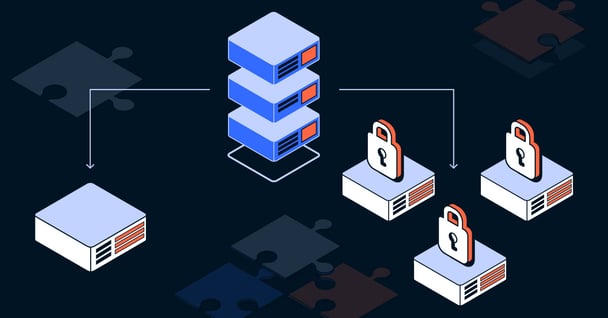
A physically isolated database means your data lives in its own dedicated environment, separate from every other organisation. Learn why this matters for family offices.
The objections single family offices raise against AI adoption, from data security to discretion, and why AI built specifically for the SFO context resolves each one.
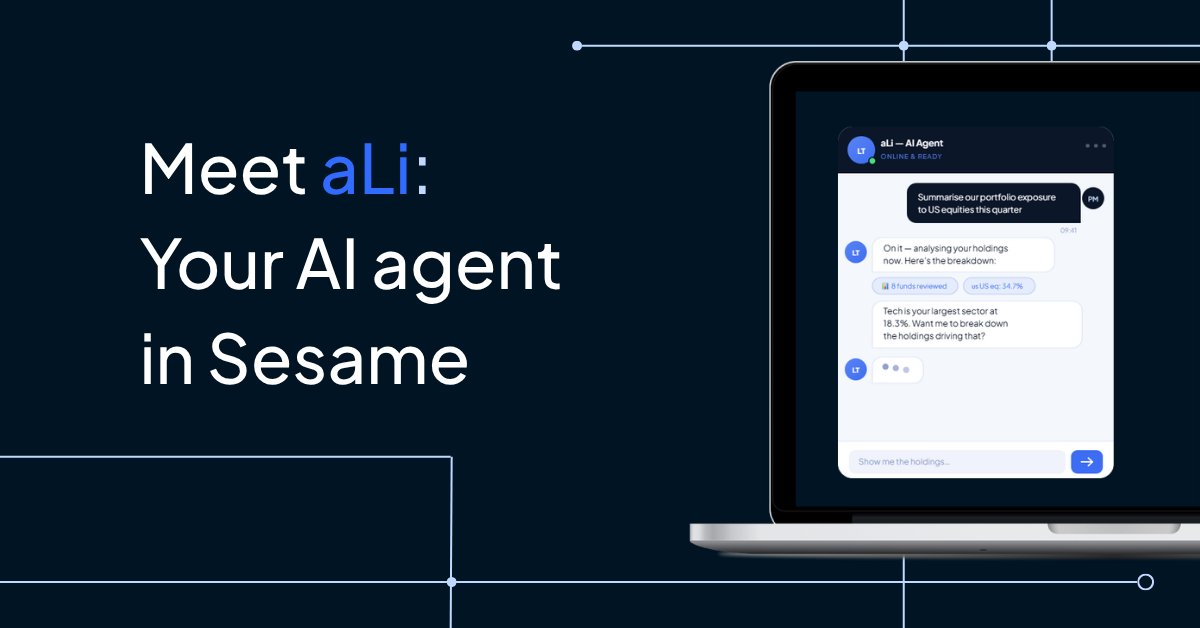
Discover aLi, the AI agent built for family offices inside Sesame One. Ask questions, get instant portfolio insights, and spend less time searching for answers.
Family office reporting is shifting from static, scheduled documents to on-demand, AI-powered insight. A look at where the standard is heading, what is driving the change, and what it means for how offices serve the family.
Manual data sourcing costs family offices time and accuracy. Learn how the most sophisticated offices are replacing manual processes with automation and AI.
Find out how family offices across the globe are using Sesame One to take control of their data, reclaim time, and deliver reporting that genuinely impresses.
Family offices manage some of the most complex data environments in private wealth. A look at the five data challenges that consume the most time, create the most risk, and matter most to address.
Alternative investments now account for nearly half of family office holdings. A look at the five reporting challenges this creates and how the best-run offices are addressing them.
In a data-driven world, trusted advisors need more than information. See how better data foundations unlock clarity, insight and stronger client relationships.
Manual processes, fragmented data, and time-consuming reporting are the productivity challenges most family offices share. A look at where the hours are going and what the best-run offices are doing differently
Family offices today have likely already invested in digital tools, reporting platforms, and cybersecurity frameworks. But without a long-term structured and secure data foundation, all of that rests on shaky ground.
Guest author and structured product specialist, AYDO, explores how these instruments may help investors navigate uncertain markets through defined outcomes and tailored exposure
Explore key governance practices for family offices to achieve stability, longevity, and success, including investment committees, non-executive directors, and reputation management.
Landytech is delighted to be featured as one of the world’s leading family office software providers, in the 2022 Forbes Family Office Software Roundup.
As family offices deliberate on how best to navigate the choppier waters ahead, here are five ways that data and technology can help you stay on the front foot in volatile markets.
Intergenerational wealth transfer is one of the main causes of client attrition, as clients pass and beneficiaries take their assets elsewhere. How can technology help multi-family offices deepen relationships with future generations.
Ultra-high-net-worth (UHNW) families typically have a plethora of accounts, portfolios, trusts and managers, yet not having a complete picture of their holdings can be frustrating.
Landytech is delighted to announce the completion of its Series A funding of $6m. The funding has been raised primarily from Adelie Capital and Greenwood Way Capital, a number of family offices and financial influencers also participated in the funding round.
The art market is growing again, its buyers are getting younger, and far fewer of them want to sell. For family offices, fine art is earning a place alongside every other asset on the balance sheet.
Ask most family office operations teams where their consolidation breaks down, and the answer is rarely the custodian feeds. It's everything that arrives outside them: the bank statement from an institution with no feed, the capital call notice from a private fund, the quarterly update that lands as a PDF. Each one holds holdings and transactions the consolidation needs. Yet for most family offices and asset owners, getting that data into the system has always meant someone reading the document and keying it in by hand.
Ask most family office finance teams which part of the quarter they dread most, and the answer is often a tie: investment reporting and closing the books. Both draw on exactly the same activity, the same trades, cash movements and income events. Yet for most family offices and asset owners, they have always lived in separate systems, maintained separately.
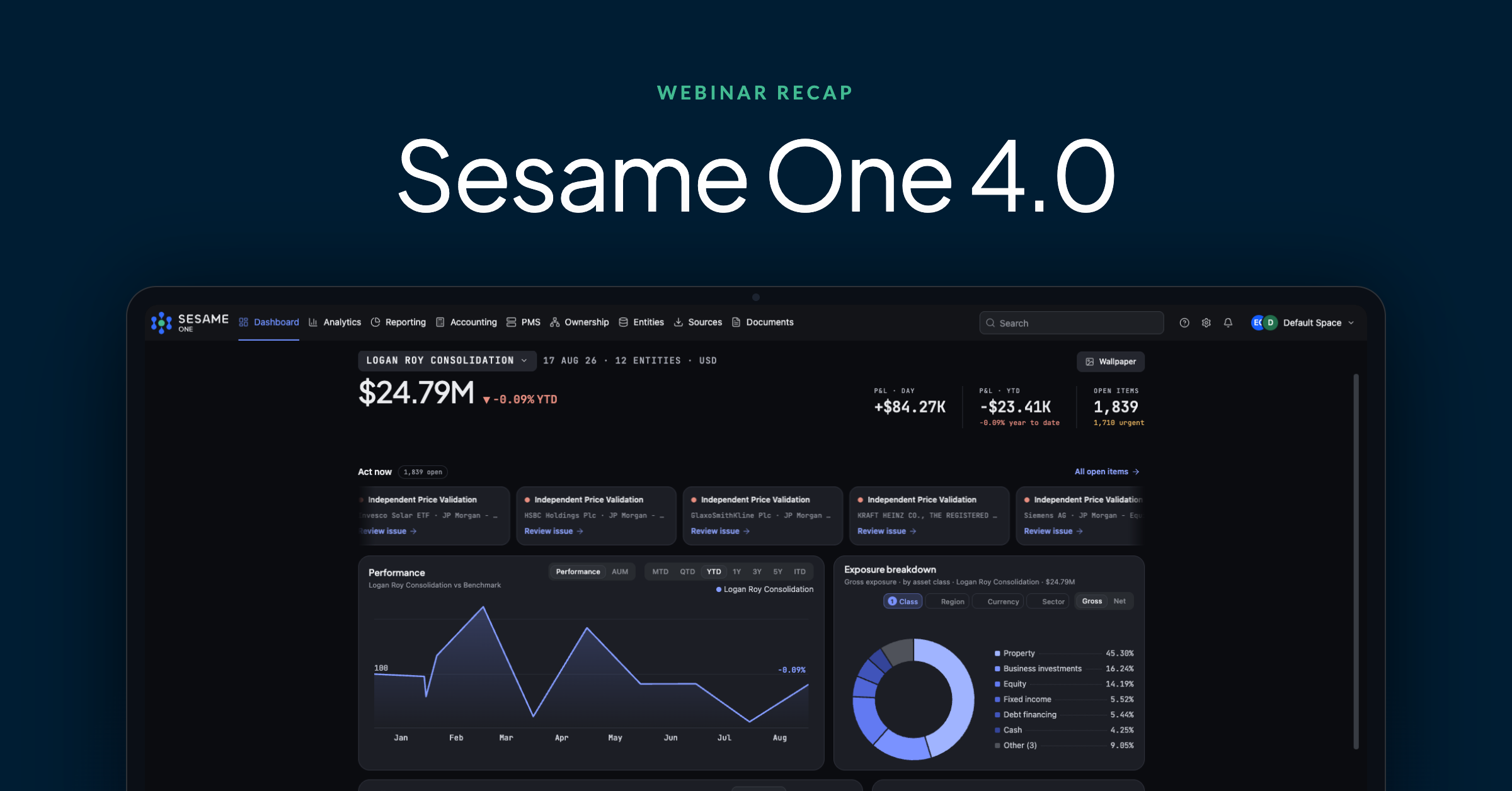
Last week we hosted the launch webinar for Sesame One 4.0, the biggest release in the platform's history. Hugh from our product marketing team walked through the thinking behind the release and the new capabilities, and our product team, Benjamin, Ramis and Eddie, answered a packed round of audience questions.
If you missed it, or want a refresher, here are the highlights.
Build versus buy: how family offices should evaluate technology infrastructure in the AI era
For most single family offices, the build versus buy question is no longer a close call. Complex portfolios, more jurisdictions, and rising AI expectations have raised the bar for what any internal team can realistically maintain. What matters most today: how custodial data feeds are maintained, how data integrity is protected, and how that data becomes usable analytics.
Every family office is being asked the same question: are you ready for AI? Most answer it by evaluating tools, comparing chatbots, dashboards and copilots, as if readiness were a shopping decision. AI is only as useful as the data it can see, though, and for most family offices that data is scattered across several systems that don't speak to each other. Readiness has little to do with which tool gets chosen, and everything to do with what sits underneath it.
The Citi Institute's AI in the Family Office report (May 2026) maps the fintech landscape for single family offices working through vendor evaluation, with Landytech included among the providers in the performance reporting and intelligence space.
Family offices are becoming more sophisticated, more global and more complex. As the Ocorian Global Family Office Report highlights, they are evolving into institutional-grade organisations, yet many are still operating on fragmented data foundations.
The single family office software market has expanded significantly in recent years, with more platforms competing for the same mandates than at any previous point. For a UK or European single family office beginning or reviewing a software evaluation, the volume of options is not the challenge. The challenge is knowing which capabilities to prioritise and which vendor claims to scrutinise.
London, 28 May 2026 — Landytech, the company behind the all-in-one investment management platform for family offices, Sesame One, today announced a strategic partnership with Tamarix, an AI operating system for limited partners purpose-built to automate private markets data workflows. The partnership enables family offices to manage alternatives with the same discipline as traditional assets, by automating private markets data from Tamarix into Sesame One.
Data aggregation is the least visible part of a family office platform and the most consequential. It is the layer nobody sees in a demonstration, the capability that rarely features in a vendor's marketing materials, and the foundation on which every report, every analytics output, and every AI-generated response depends. It is also the area where the gap between platforms claiming equivalent capability is widest.
The conversation about AI in family offices has moved quickly from whether to consider it to how to implement it well. For offices that have decided AI is worth pursuing, the most important question is not which AI tool to choose. It is whether the data environment the AI will operate on is ready to support it.
The family office software market has expanded significantly in recent years. There are more platforms, more feature sets, and more vendors claiming to solve the same problems than at any previous point. For a family office beginning or revisiting an evaluation, the volume of options available is not the difficult part. The difficult part is knowing which questions to ask, which answers to take seriously, and which capabilities to prioritise over which others.
The spreadsheet is one of the most enduring tools in the family office. Flexible, familiar, and available without any implementation project or vendor relationship, it has served as the default system for data consolidation, portfolio tracking, and report production for as long as most teams can remember. For many offices, it still does.
The single family office is built on a particular kind of relationship. One that has been developed over years, sometimes decades, and that depends at every point on discretion, reliability, and the confidence that sensitive information will never be handled carelessly. The principals who place their wealth under the stewardship of a family office are not purchasing a service in the conventional sense. They are extending trust. Everything the office does, from its investment process to its reporting to the tools it chooses to operate with, is an expression of whether that trust is warranted.
Family office software is technology built to manage the operational and analytical demands of a family office: aggregating portfolio data from multiple sources, producing consolidated reporting across complex ownership structures, delivering the analytics and risk management capability the investment team needs to make informed decisions, and doing all of this in a way that reflects the specific governance, security, and discretion requirements of an organisation managing one family's wealth.
Institutional-grade is a phrase that appears frequently in financial technology marketing and means precisely nothing without further definition. It implies rigour, depth, and sophistication, but those qualities are only meaningful when they are translated into specific analytical capabilities that address the actual complexity of the portfolio being managed.
Data aggregation is the process of collecting portfolio data from multiple sources, standardising it into a consistent format, and presenting it as a single, unified view of the family's wealth. Instead of reviewing statements from individual banks, custodians, fund administrators, and private asset managers separately, the office works from one consolidated picture that reflects the complete portfolio in real time.
A physically isolated database is a data environment that is dedicated entirely to one organisation and architecturally separate from the data of any other. The family office's data does not share infrastructure, processing layers, or storage with any other organisation using the same platform. It exists in its own environment, under its own controls, accessible only to those the office has explicitly authorised.
Consolidated reporting is the production of a single, unified view of a portfolio across all assets, custodians, currencies, and legal structures. Rather than reviewing statements from individual banks, fund managers, and administrators in isolation, consolidated reporting brings all of that information together into one coherent picture, updated from a single data source, and presented in a format that reflects the way the family actually holds its wealth.
The decision to adopt AI in a single family office is not a technology procurement exercise. It is a question of partnership, and it deserves the same rigour the office applies to every other significant relationship it enters. The vendor landscape is expanding quickly, and the claims made within it are not always matched by the substance behind them. A family office that approaches AI selection with the same discipline it brings to counterparty due diligence will make a significantly better decision than one that evaluates on capability alone.
Three objections come up reliably when single family offices are asked about AI. The technology is built for a different kind of institution. The data risks are too significant. And the office simply does not have the problem AI is designed to solve. Each of these positions is reasonable. Each of them is also becoming harder to hold.
"The data risk is too great"
This is precisely the right question to ask, and the standard it implies is exactly the right one to apply. A single family office manages some of the most sensitive financial information in existence. Many AI tools currently available were designed for enterprises willing to accept shared infrastructure as a condition of convenience. That is a trade-off the SFO context does not permit.
The appropriate response is to demand AI built with this environment in mind: architectures in which data is held in fully isolated, per-client environments, security credentials that are independently audited and verifiable, and systems over which the office retains complete control. That standard exists. The question is whether the tools being evaluated meet it.
"AI was built for large institutions, not for us"
The early wave of AI in financial services was indeed designed for scale. Institutions managing thousands of accounts, processing millions of data points, and searching for signal in volumes of information no team could manually review. That challenge has little in common with the single family office, where proximity to the portfolio has never been the issue.
The SFO's problem is a different one. Time disappears into reconciling data across custodians, assembling performance summaries ahead of review meetings, and responding to questions from the principal that require several members of the team to pause their work and locate an answer before the following morning. This is not complex work, but it consumes hours that would otherwise be directed toward judgement, relationships, and considered thinking that no software can replicate. The opportunity cost, compounded across weeks and quarters, is substantial. AI designed for the SFO context addresses precisely this: not the scale problem of the institution, but the repetition problem of the specialist team.
"We don't have the problem AI solves"
This objection tends to dissolve when the question is made specific. How long does it take to answer an ad hoc question from the principal? How much preparation time goes into a review meeting? How many hours per week does the team spend retrieving and formatting information rather than analysing it?
When those conditions are satisfied by the right tools, the day-to-day experience of the team changes in practical ways. A question that previously required pulling data from multiple sources takes minutes rather than hours. A performance summary that once demanded significant preparation can be assembled more quickly. The investment philosophy of the office remains unchanged. The relationships, the discretion, the judgement that defines a well-run SFO, none of that is altered. What improves is the speed at which routine information tasks are completed, freeing the team's attention for work that genuinely requires their expertise.
The case for acting now is about stewardship
The strongest argument for AI in the single family office is not operational. The family office exists to steward wealth across generations, and that responsibility is best discharged by a team with the time and information to think clearly, advise confidently, and act decisively. When routine data tasks consume a disproportionate share of the team's week, portfolio analysis is shallower than it should be, decisions are made under time pressure, and the quality of insight presented to the family suffers quietly. A team that can retrieve and synthesise information quickly is a team that spends more time on the work that genuinely serves the family. Over years, that difference compounds in ways that matter far more than any single efficiency gain.
Single family offices manage multi-custodian, multi-entity, multi-currency wealth across public and private markets, typically with a small team. The capability is there. The raw data is there. But when a family or team member asks a simple question: "how did we perform last quarter?" or "what's our exposure to US tech?" the answer still takes half a day.
The path from question to answer runs through an analyst, a spreadsheet and a manually built report. Industry surveys suggest more than half of asset owners still rely on spreadsheets for this work, consuming roughly a week of manual effort every month. That is time the team is not spending on decisions that improve portfolio performance.
Family office reporting has changed more in the past three years than in the previous decade. The combination of automated data aggregation, institutional-grade analytics, and now AI-powered querying has shifted what is technically possible to a point where the static quarterly PDF, assembled manually from custodian statements, is no longer an adequate benchmark. For offices that have not kept pace, the gap between what they produce and what the best-run offices deliver is widening.
The data challenge facing a modern single family office is not a shortage of information. It is an excess of it, arriving from too many sources, in too many formats, on too many different schedules, with no common standard between them. How a family office chooses to address that challenge has a direct bearing on the quality of its reporting, the reliability of its investment decisions, and the amount of time its team spends on work that genuinely requires their expertise.
Family office reporting has changed. The days of emailing Excel files between custodians, manually reconciling positions across spreadsheets, and presenting a static PDF once a quarter are numbered. Families are more sophisticated, portfolios are more complex, and the bar for service has never been higher.
The data environment of a family office is, by its nature, one of the most complex in private wealth management. Wealth held across multiple custodians, asset classes, legal structures, and geographies. Private investments that arrive with no automated feed. Alternative allocations documented in unstructured PDFs weeks after month-end. And behind all of it, a team that is expected to produce timely, accurate, and comprehensive reporting from information that arrives in dozens of incompatible formats on dozens of different schedules.
Alternative investments have moved from the periphery of family office portfolios to the centre of them. Private equity, real estate, hedge funds, direct investments, and a growing range of other alternative structures now account for a substantial share of total holdings, with allocations continuing to rise as families pursue returns that listed markets alone cannot reliably deliver.
The productivity challenge facing most family offices is not a shortage of capability or ambition. It is a structural one. The processes built around data management, reporting, and portfolio oversight were designed for a simpler operating environment, and they have not kept pace with the complexity of the portfolios they now serve.
Markets may be near historical highs, yet many investors are increasingly focused on resilience rather than returns alone. Volatility has become more frequent, policy visibility remains limited, and geopolitical developments continue to influence capital markets.
In the December 2025 issue of the We Wealth Family Office & Family Business magazine, Landytech CEO Benjamin Mouté shares his insights on how digital platforms are reshaping family wealth management, helping Italian Family Offices gain clarity, control and transparency over increasingly complex, multi-asset and multi-jurisdictional portfolios.
The original article in Italian can be accessed on the We Wealth website here.
For decades, family offices have relied on trusted relationships and private networks to access opportunities in alternative investments. Introductions from peers, long-standing fund manager connections and closed-door referrals have formed the foundation of deal sourcing.
Today’s family offices want to deliver a strong risk-adjusted investment performance that is aligned with family members’ priorities. To prove the value they’re adding, they also want to be able to communicate that performance, and the value of holdings, to families.
Landytech is delighted to be featured as one of the global leaders in family office technology in the 2023 Forbes Family Office Software Roundup. The roundup highlights companies supporting the core functions of data aggregation, day-to-day management, and reporting. Many family offices refer to the Forbes shortlist of providers as an invaluable resource when choosing a technology partner.
Discover how a London-based family office replaced an Excel-based ledger system with Landytech’s Sesame One, a consolidated investment reporting platform designed for family offices, saving days each month on data consolidation and reporting.
Reporting on portfolios spanning multiple asset classes, currencies and geographies is a time intensive, manual process, often prone to errors. This complexity and the difficulties involved in producing consolidated reporting can result in concentration risk, inflated costs and ill-informed investment decisions.
Landytech is delighted to be featured as one of the world’s leading family office software providers, in the 2022 Forbes Family Office Software Roundup.
The report pays particular attention to companies supporting the core functions of data aggregation, day-to-day management, and reporting. Many family offices see the Forbes shortlist of providers as an invaluable resource when choosing a technology partner.
The report also shares insights into how family offices are adapting to turbulent markets, the ongoing cybersecurity threat, and the importance of planning for the next generation of wealth owners.
Landytech is the company behind Sesame, the investment reporting platform that brings clarity to complex wealth, enabling family offices to streamline processes and make more informed investment decisions.
After almost two years of record returns, market volatility and the looming threat of recession has left family offices anxious. Amid continued inflationary pressure and lower expected returns, some are looking to increasingly exotic portfolio diversifiers for outsized returns, whilst others seek to reduce risk and play it safe. All, however, are seeking opportunities to streamline their operations, against a backdrop of rising costs.
In recent years, family office portfolios have benefited from robust economic growth, relative geopolitical stability, persistently low inflation and interest rates, and relatively low volatility. But family offices, just like other financial market participants, now face greater uncertainty and elevated levels of market volatility.
A considerable proportion of global wealth is owned by individuals who are close to or older than 60 years old – it’s been estimated that more than US$30 trillion will be transferred from one generation to the next over the next few decades.
Most family office advisors have spent the majority of their careers providing investment and financial advice to affluent baby boomers. But an aging client base poses a considerable risk to the long-term viability of multi-family offices.
Intergenerational wealth transfer is one of the main causes of client attrition, as clients pass, and beneficiaries take their assets elsewhere. If multi-family offices don’t develop relationships with their clients’ heirs, the chances of retaining assets are low.
So, how can technology help multi-family offices to deepen relationships with future generations now to ensure their business is futureproofed for decades to come?
Ultra-high-net-worth (UHNW) families typically have a plethora of accounts, portfolios, trusts and managers. Yet not having a complete picture of their holdings can cause them frustration. In light of this, they are increasingly turning to their family offices to deliver the consolidated reporting that will provide the visibility they desire.
Landytech is delighted to announce the completion of its Series A funding of $6m. The funding has been raised primarily from Adelie Capital and Greenwood Way Capital, a number of family offices and financial influencers also participated in the funding round.



.png)
.png)
.png)


.png)









.png)

.png)

.png)




.png)

.png)


.png)