.png?width=1200&height=675&name=FO%20AI%20era%20(2).png)
Ask most family office finance teams which part of the quarter they dread most, and the answer is often a tie: investment reporting and closing the books. Both draw on exactly the same activity, the same trades, cash movements and income events. Yet for most family offices and asset owners, they have always lived in separate systems, maintained separately, and brought together by hand.
That's starting to change, and expectations are changing with it.
The same transactions, handled twice
A family office's investment platform already holds a complete picture of portfolio activity. Custodian feeds, open banking connections and private fund statements bring every holding and transaction into one consolidated view.
Until now, that data has typically stopped there. To produce journal entries and a general ledger, teams have had two options. The first is to re-key the data downstream, taking figures the investment platform already sourced automatically and entering them again in the accounting system. The second is to rely on third-party integrations and mapping tools to translate investment activity into accounting records, which then need their own setup, monitoring and upkeep.
Either way, it's somebody's job to move the same numbers from one place to another. For lean teams, that's time spent on transfer and checking rather than analysis.
Why the expectation has shifted
The logic is simple. If the investment platform already holds every transaction, accurately consolidated across entities and asset classes, then the accounting records should come from the same place.
Two things have made that expectation much harder to ignore.
The first is team size. Many family offices run with small teams wearing several hats. Every system they maintain, and every integration between systems, adds to the workload of people who are already stretched.
The second is AI. AI is only as useful as the data it can see. When investment and accounting records sit in separate systems, any AI tool is working from part of the picture. Connecting those systems for AI means building more integrations, each one another thing to maintain and another point where sensitive data moves between environments.
Configuration has always been the hidden cost
Generating journal entries automatically has been possible for a long time. The difficulty has been the setup.
Traditional accounting systems require the rules behind every posting to be defined by hand, often by writing out the formatting and expressions that decide how each type of transaction is classified. That work requires specialist knowledge, and it never really finishes. New entities, new asset classes and new structures all mean revisiting the rules.
For a family office without a dedicated accounting systems specialist, this configuration burden has been one of the biggest reasons accounting has stayed separate from investment reporting.
How AI takes on the configuration work
This is where AI makes a practical difference.
With Accounting in Sesame One, teams upload the chart of accounts they already use in their existing accounting system, and aLi, the AI assistant in Sesame One, helps configure it. Journal entry rules can then be created in natural language: describe how a type of transaction should be treated, and aLi helps build the rule, rather than a specialist writing the expressions by hand.
Importantly, AI helps with the setup, while the postings themselves remain deterministic. Once the rules are in place, the same input always produces the same output, which is exactly what an accounting record requires.
The engine also calculates realised and unrealised P&L, with FIFO, LIFO or weighted average cost basis configurable by entity, by portfolio, and even for individual positions. The flexibility sits in the configuration, and AI makes that configuration far quicker to set up and maintain.
A general ledger that works with your existing accounting system
Accounting in Sesame One generates journal entries and a general ledger directly from the portfolio activity already in Sesame One, ready to export into the accounting system a family office already uses. Nobody has to re-key investment data downstream, and the quarterly close can move faster as a result.
.png?width=749&height=246&name=handled-twice-diagram%20(1).png)
It's built for family offices and asset owners who already rely on Sesame One for their investment book of record and want the same data to produce their accounting records.
One system of record for your team and your AI
With investment analysis and accounting stored in the same place, family offices and asset owners now have a single system of record. Sesame One brings together the investment book of record, the corporate book of record covering entities, ownership structures and documents, and now the accounting book of record.
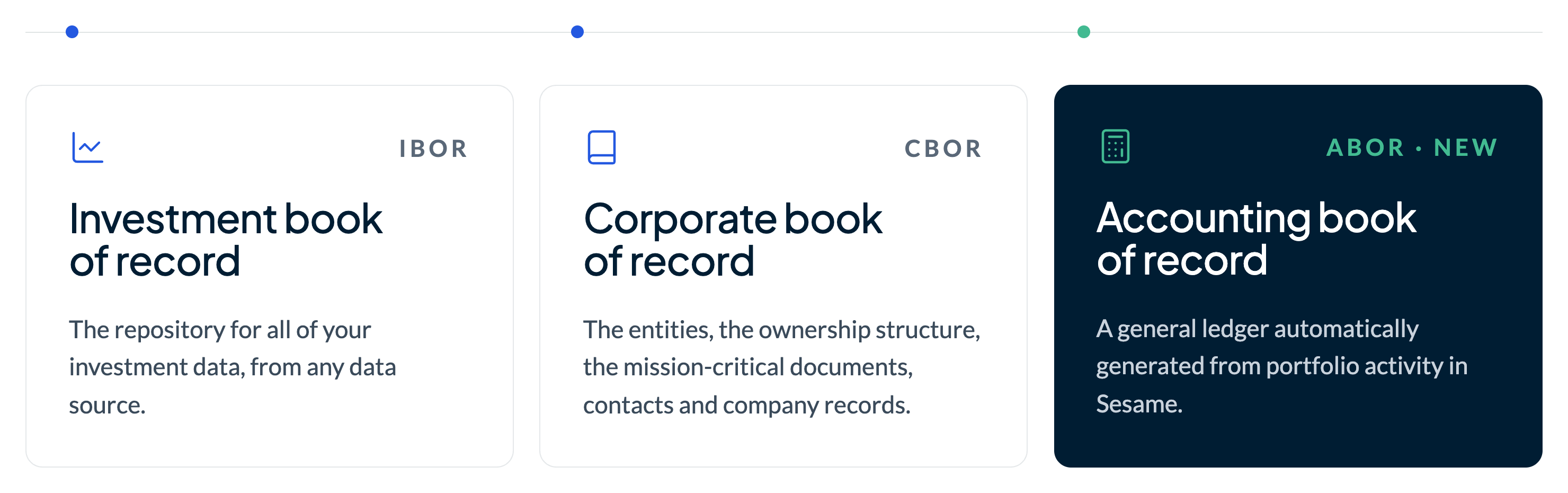
That matters for the team, who work from one set of numbers rather than two. It matters for AI too. When aLi answers a question or helps build a report, it's drawing on the complete record, using the same calculations as the rest of the platform, so every figure can be checked.
The quarterly close was never meant to be a second round of data entry. With investment and accounting records generated from one system, it no longer has to be.
Explore Sesame One 4.0 to find more about accounting in Sesame One.
.png?width=400&height=225&name=FO%20AI%20era%20(1).png)