
.png?width=1200&height=675&name=FO%20AI%20era%20(3).png)
Ask most family office operations teams where their consolidation breaks down, and the answer is rarely the custodian feeds. It's everything that arrives outside them: the bank statement from an institution with no feed, the capital call notice from a private fund, the quarterly update that lands as a PDF. Each one holds holdings and transactions the consolidation needs. Yet for most family offices and asset owners, getting that data into the system has always meant someone reading the document and keying it in by hand.
That's starting to change, and expectations are changing with it.
The statements that fall outside the feed
Automated feeds from banks and custodians remain the best way to bring investment data into a consolidation. But feeds don't reach everywhere. Some institutions lack the technical infrastructure to set one up. For others, a feed simply isn't commercially viable. And when a new client is being onboarded, there is often a gap of weeks before feeds go live.
Private funds are a different challenge altogether. Capital calls, distributions and quarterly fund updates arrive directly from general partners as documents, with no feed to connect to at all.
Until now, teams have had two options. The first is to process these documents manually, reading each one, extracting the figures and entering them into the investment platform. The second is to use document tools that handle one file at a time, still leaving someone to check the output, map it to the right portfolio and post it.
Either way, it's somebody's job to turn documents into data. For lean teams, that's time spent on data entry rather than analysis.
Why the expectation has shifted
The logic is simple. If the investment platform is the single place a family office relies on for its full picture of wealth, then every holding and transaction should reach it, whatever format it arrives in.
Two things have made that expectation much harder to ignore.
The first is team size. Many family offices run with small teams wearing several hats. Every document processed by hand adds to the workload of people who are already stretched, and that workload peaks at exactly the moment they're busiest, at quarter end.
The second is AI. AI is only as useful as the data it can see. When private fund positions or a bank account without a feed are missing from the consolidation, any AI tool is working from part of the picture, and every answer it gives is incomplete.
Manual processing has always been the hidden cost
Reading a single statement takes minutes. The difficulty is everything around it.
Each document needs its holdings and transactions extracted accurately, matched to the right portfolio and entity, and checked against what's already in the system. New holdings that haven't appeared before need to be created. Then the data has to be posted. Multiply that across every fund, every account without a feed and every quarter, and document processing becomes one of the most persistent manual workloads in the office.
For a family office with significant private market exposure, this processing burden has been one of the biggest reasons the consolidation is rarely complete when it's needed.
How AI agents take on the processing work
This is where AI makes a practical difference.
With Doc Flow in Sesame One, teams upload bank statements and private fund documents as they arrive, one at a time or many at once. A series of AI agents then reads each document, extracts the holdings and transactions, enriches the data, and creates new holdings where they haven't appeared before. The data is mapped to the right portfolios based on mapping rules the team sets, which can be added to and refined over time, and posted straight into Sesame One.
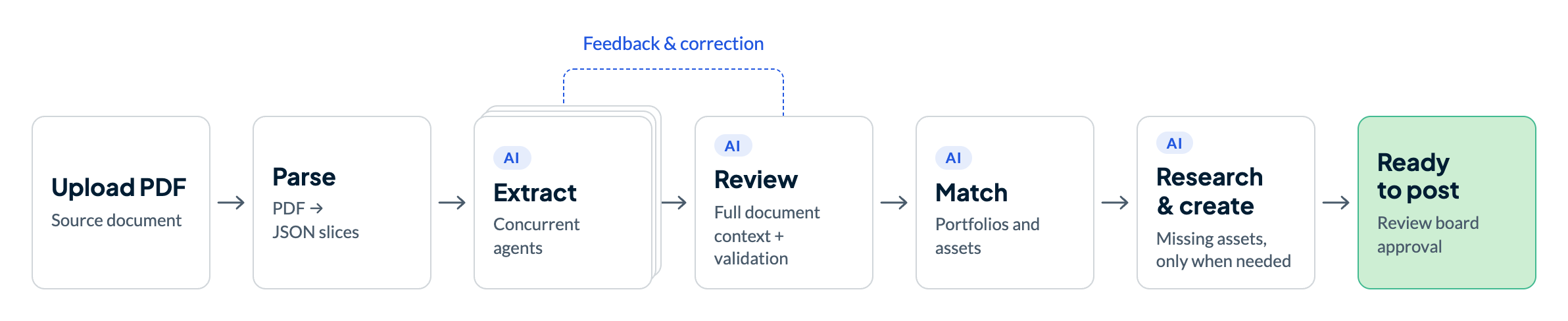
Importantly, the team stays in control of what gets posted. Every extracted figure is traceable to the document it came from, and a configurable review step lets the team check the data before it reaches the system. Trusting automated extraction is built up over time, and the review step is there to support exactly that.
The AI models themselves run within Microsoft Azure, so documents stay within a secure environment and are never used to train the models.
A complete consolidation that works alongside your feeds
Doc Flow is designed to fill the gaps that feeds leave, rather than replace them. Automated feeds remain the primary route wherever they're available. Doc Flow covers the rest: banks without a feed, new clients being onboarded before feeds go live, and private fund documents, where manual processing was previously the only option available.
It's built for family offices and asset owners who rely on Sesame One for their investment book of record and want every document, from every source, to reach it without being keyed in by hand.
One system of record for your team and your AI
Data processed through Doc Flow lands in the same investment book of record as data from custodian feeds. From there, it flows into everything else in Sesame One: analytics, reporting, and Accounting in Sesame One, which generates journal entries and a general ledger from the same portfolio activity.
That matters for the team, who work from one complete consolidation rather than a picture with gaps in it. It matters for AI too. When aLi answers a question or helps build a report, it's drawing on every holding and transaction, including the ones that arrived as documents.
Quarter end was never meant to be a document-sorting exercise. With AI agents processing statements as they arrive, it no longer has to be.
Explore Sesame One 4.0, the investment management platform for the AI era.
.png?width=400&height=225&name=FO%20AI%20era%20(2).png)
.png?width=400&height=225&name=FO%20AI%20era%20(1).png)