AI capability in a family office is only as good as the data infrastructure beneath it. A look at what needs to be in place before AI delivers reliable insight.
The questions family offices ask about AI are not really technology questions. They are trust questions. A look at what trustworthy AI looks like in practice and the standards worth insisting on.
The objections single family offices raise against AI adoption, from data security to discretion, and why AI built specifically for the SFO context resolves each one.
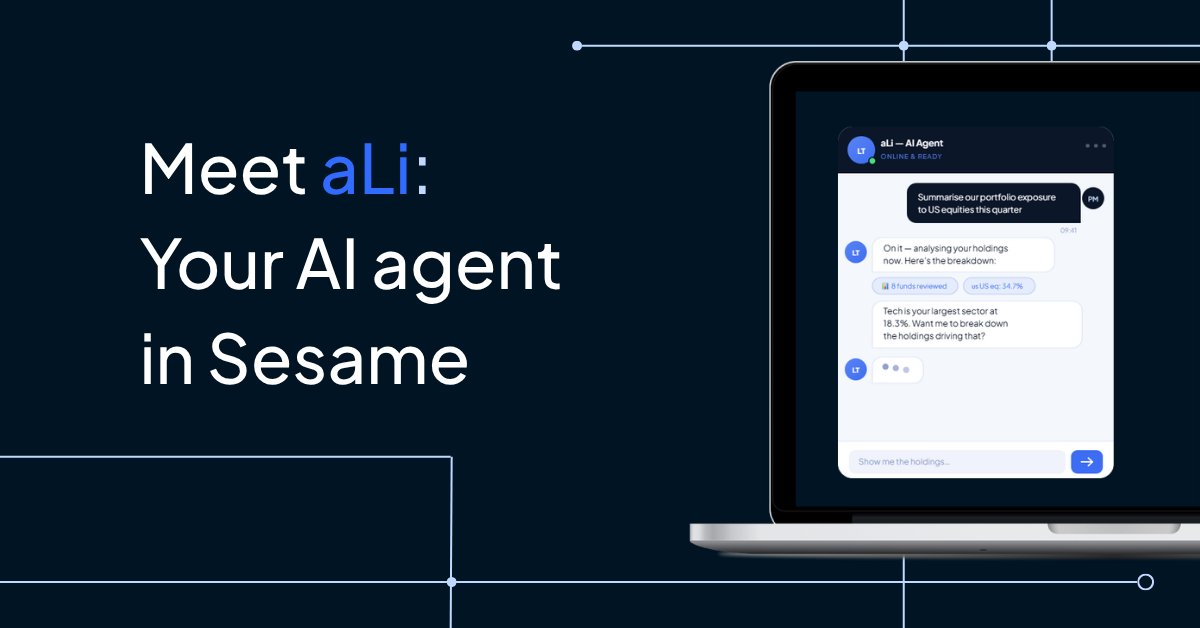
Discover aLi, the AI agent built for family offices inside Sesame One. Ask questions, get instant portfolio insights, and spend less time searching for answers.
The conversation about AI in family offices has moved quickly from whether to consider it to how to implement it well. For offices that have decided AI is worth pursuing, the most important question is not which AI tool to choose. It is whether the data environment the AI will operate on is ready to support it.
The single family office is built on a particular kind of relationship. One that has been developed over years, sometimes decades, and that depends at every point on discretion, reliability, and the confidence that sensitive information will never be handled carelessly. The principals who place their wealth under the stewardship of a family office are not purchasing a service in the conventional sense. They are extending trust. Everything the office does, from its investment process to its reporting to the tools it chooses to operate with, is an expression of whether that trust is warranted.
The decision to adopt AI in a single family office is not a technology procurement exercise. It is a question of partnership, and it deserves the same rigour the office applies to every other significant relationship it enters. The vendor landscape is expanding quickly, and the claims made within it are not always matched by the substance behind them. A family office that approaches AI selection with the same discipline it brings to counterparty due diligence will make a significantly better decision than one that evaluates on capability alone.
Three objections come up reliably when single family offices are asked about AI. The technology is built for a different kind of institution. The data risks are too significant. And the office simply does not have the problem AI is designed to solve. Each of these positions is reasonable. Each of them is also becoming harder to hold.
"The data risk is too great"
This is precisely the right question to ask, and the standard it implies is exactly the right one to apply. A single family office manages some of the most sensitive financial information in existence. Many AI tools currently available were designed for enterprises willing to accept shared infrastructure as a condition of convenience. That is a trade-off the SFO context does not permit.
The appropriate response is to demand AI built with this environment in mind: architectures in which data is held in fully isolated, per-client environments, security credentials that are independently audited and verifiable, and systems over which the office retains complete control. That standard exists. The question is whether the tools being evaluated meet it.
"AI was built for large institutions, not for us"
The early wave of AI in financial services was indeed designed for scale. Institutions managing thousands of accounts, processing millions of data points, and searching for signal in volumes of information no team could manually review. That challenge has little in common with the single family office, where proximity to the portfolio has never been the issue.
The SFO's problem is a different one. Time disappears into reconciling data across custodians, assembling performance summaries ahead of review meetings, and responding to questions from the principal that require several members of the team to pause their work and locate an answer before the following morning. This is not complex work, but it consumes hours that would otherwise be directed toward judgement, relationships, and considered thinking that no software can replicate. The opportunity cost, compounded across weeks and quarters, is substantial. AI designed for the SFO context addresses precisely this: not the scale problem of the institution, but the repetition problem of the specialist team.
"We don't have the problem AI solves"
This objection tends to dissolve when the question is made specific. How long does it take to answer an ad hoc question from the principal? How much preparation time goes into a review meeting? How many hours per week does the team spend retrieving and formatting information rather than analysing it?
When those conditions are satisfied by the right tools, the day-to-day experience of the team changes in practical ways. A question that previously required pulling data from multiple sources takes minutes rather than hours. A performance summary that once demanded significant preparation can be assembled more quickly. The investment philosophy of the office remains unchanged. The relationships, the discretion, the judgement that defines a well-run SFO, none of that is altered. What improves is the speed at which routine information tasks are completed, freeing the team's attention for work that genuinely requires their expertise.
The case for acting now is about stewardship
The strongest argument for AI in the single family office is not operational. The family office exists to steward wealth across generations, and that responsibility is best discharged by a team with the time and information to think clearly, advise confidently, and act decisively. When routine data tasks consume a disproportionate share of the team's week, portfolio analysis is shallower than it should be, decisions are made under time pressure, and the quality of insight presented to the family suffers quietly. A team that can retrieve and synthesise information quickly is a team that spends more time on the work that genuinely serves the family. Over years, that difference compounds in ways that matter far more than any single efficiency gain.
Single family offices manage multi-custodian, multi-entity, multi-currency wealth across public and private markets, typically with a small team. The capability is there. The raw data is there. But when a family or team member asks a simple question: "how did we perform last quarter?" or "what's our exposure to US tech?" the answer still takes half a day.
The path from question to answer runs through an analyst, a spreadsheet and a manually built report. Industry surveys suggest more than half of asset owners still rely on spreadsheets for this work, consuming roughly a week of manual effort every month. That is time the team is not spending on decisions that improve portfolio performance.




.png)