Single family offices manage multi-custodian, multi-entity, multi-currency wealth across public and private markets, typically with a small team. The capability is there. The raw data is there. But when a family or team member asks a simple question: "how did we perform last quarter?" or "what's our exposure to US tech?" the answer still takes half a day.
The path from question to answer runs through an analyst, a spreadsheet and a manually built report. Industry surveys suggest more than half of asset owners still rely on spreadsheets for this work, consuming roughly a week of manual effort every month. That is time the team is not spending on decisions that improve portfolio performance.
aLi is built to change that.
From question to answer, in seconds
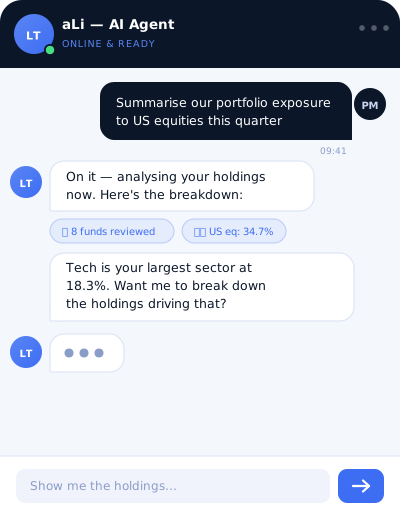
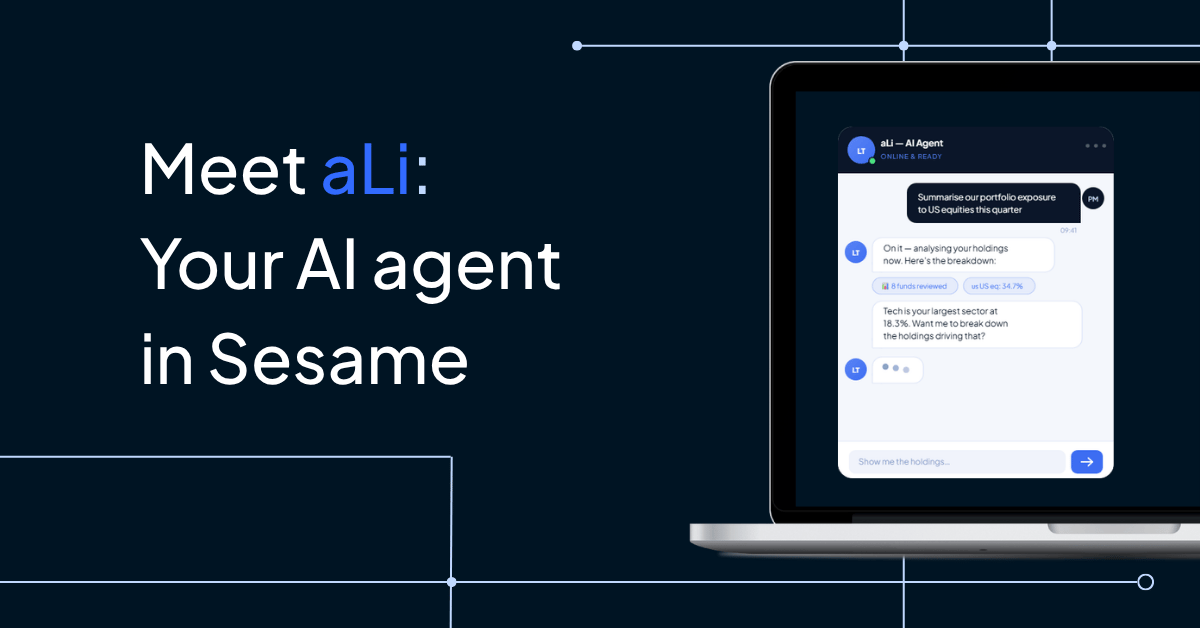
aLi is the AI agent inside Sesame One. It sits on top of your consolidated data: public holdings, private funds, alternative assets, multi-entity structures, multi-currency positions, and lets you query it in plain English.
Ask a question. Receive structured answers, with charts and figures, drawn directly from your data.
Three things underpin how it works in practice.
It only works on your data. aLi queries your own physically isolated Sesame database. There is no shared model trained, and no data shared across clients.
It respects your permissions. Users see only the data they already have access to.
Answers are fully traceable. Each figure is anchored to the underlying records in your Sesame database, explainable at any level of detail.
What your team can do with aLi
Query your data in plain English. Ask "How did we perform this month?", "What are our biggest exposures?" or "Which holdings drove returns?" and receive structured tables, charts and figures instantly, drawn from your live data.
Generate charts on demand. Ask for a chart and receive one instantly, drawn from your live data, so you can instantly visualise key portfolio drivers
Process private fund documents. Capital call notices, distribution notices, fund statements. aLi extracts the relevant data using document parsing, removing one of the most persistent manual tasks for any office with private fund exposure.
Continue the thread. Analysis rarely stops at the first question. aLi keeps persistent context in mind so you can move from "how did we perform?" to "which holdings drove it?" without starting over each time.
The result is a team that spends less time assembling information and more time using it.
Why family offices can't afford to be last on AI
Family offices are under three converging pressures.
Complexity is growing. AUM rises, asset classes multiply, entity structures deepen. Spreadsheets were not built for this.
Principal expectations have shifted. Families want the same speed from their office that they get everywhere else. A four-day turnaround on "what's my real estate exposure?" is no longer acceptable.
Many family offices are beginning to deploy AI tools. The question is not whether to adopt AI but where to deploy it.
Secure by design
Often, AI tools require data to be exported into third-party systems. aLi works directly on your data inside Sesame One. Each client has their own physically isolated database, meaning your data is never comingled alongside another client's. Landytech is ISO 27001 and SOC II certified, and your data does not leave your environment to generate an answer.
aLi is one part of a complete operating system
aLi is the intelligence layer inside Sesame One, Landytech's operating system for family offices. The platform covers the full investment lifecycle from opportunity sourcing through to analysis, portfolio management and reporting.
Today, aLi handles direct answers to data questions, chart generation and document processing. The roadmap extends it into more of the work teams do inside Sesame: portfolio management, report generation, and task automation.
Get started
If your team is still building reports to answer questions, the cost is not the time spent on the report. It is the conversations that do not happen because the answer arrived too late.
Learn more about how aLi handles the questions your team asks most often.
.png?width=400&height=225&name=FO%20AI%20era%20(1).png)