For a growing asset manager, the gap between the infrastructure you have and the infrastructure allocators expect is one of the most commercially consequential challenges you face. Institutional investors and consultants apply exacting due diligence standards before committing capital. They want to see robust risk management, accurate and timely reporting, and evidence that the firm has the operational discipline to support a significant mandate. Meeting that standard in-house, at the scale required and with the quality expected, carries a cost that most emerging and mid-sized managers cannot justify at their current stage.
The alternative is a platform that delivers institutional-grade capability without the overhead of building and running it internally. That is what Sesame is designed to do.
The data foundation everything depends on
The quality of any risk or reporting output is determined first by the quality of the data underpinning it. Sesame consolidates investment data from across an asset manager's ecosystem: prime brokers, custodians, data vendors, and portfolio management systems, normalising it into a single standardised source of truth regardless of format or origin.
The normalisation process handles the inconsistencies that make manual data management so time-consuming: different asset naming conventions, varying transaction categorisation standards, and data arriving on different schedules from different counterparties. Once standardised and stored, the data is continuously validated, with automated exception alerts that flag anomalies before they compound into errors in reporting or risk calculations.
Skerryvore Asset Management, an Edinburgh-based emerging market equity manager established in 2019, identified the value of this data foundation early. As Ian Tabberer, Portfolio Manager at Skerryvore, put it: "Landytech offers innovative solutions to the challenges we face in bringing data together from disparate sources. And by acting as a data integrator, Landytech reduces the burden on other parts of our small business."
Risk analytics that meet institutional standards
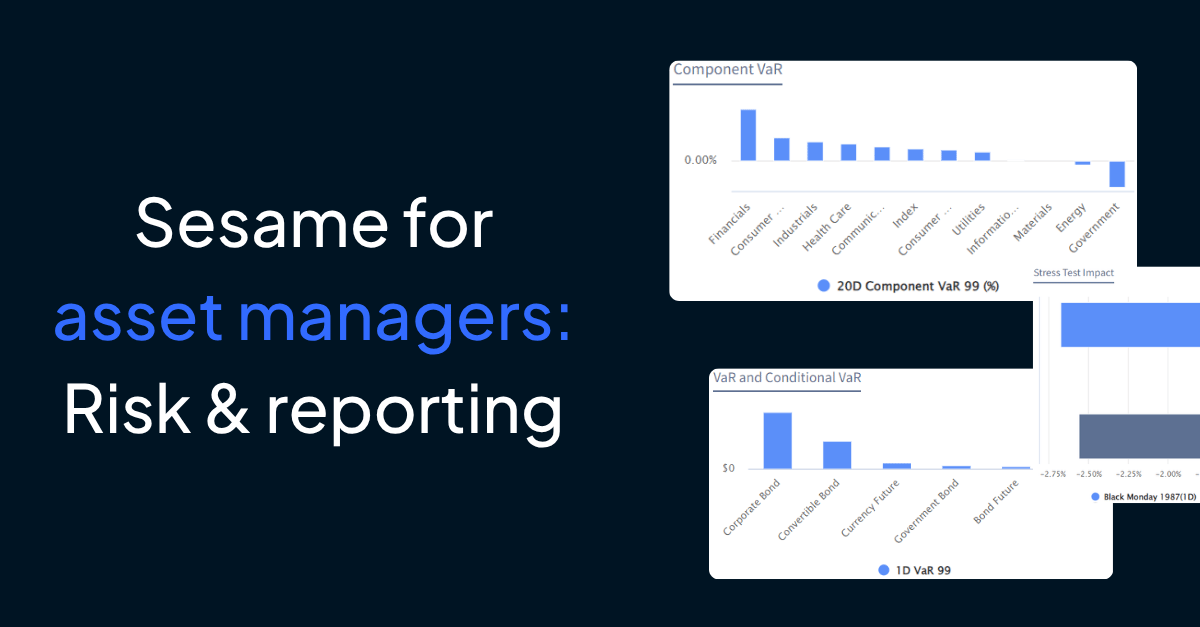
The risk analytics layer within Sesame is built around the depth and rigour that institutional allocators apply during due diligence. Through a strategic integration with MSCI RiskMetrics, the platform delivers advanced risk and performance analytics across the full spectrum of what a serious investor will scrutinise.
This includes Value at Risk calculations across the portfolio, customisable scenario analysis and stress testing both historical and forward-looking, performance contribution and attribution, portfolio sensitivities including DV01, CS01, and portfolio Greeks for credit-oriented strategies, and liquidity analysis across holdings. Risk limits can be configured to the manager's specific investment policy, with daily monitoring and automated alerts when thresholds are approached or breached.
For managers running complex strategies, the platform's ability to handle multi-asset, multi-strategy portfolios with granular position-level analytics is a specific differentiator. A UK-based multi-strategy hedge fund running convertible arbitrage strategies required coverage across convertible bonds, SPACs, high delta converts, deep value credits, and credit default swaps. Landytech built a customised risk framework covering VaR sensitivity, CS01, DV01, and portfolio Greeks, with bespoke stress test scenarios developed in RiskMetrics to meet the fund's specific requirements. The hedge fund achieved a 10% return in its first year, navigating significant market dislocation, while achieving substantial cost savings relative to building an equivalent risk function in-house.
Reporting that wins and retains institutional mandates
The reporting capability within Sesame is designed around the reality that reports are not just operational outputs. For an asset manager competing for allocations, they are a commercial asset. A well-constructed, accurate, and visually compelling report tells an investor that the manager has the operational discipline, the data infrastructure, and the analytical depth to be trusted with a significant mandate.
Sesame's Report Builder allows the creation of fully branded, configurable reports without requiring IT expertise or coding knowledge. Metrics, layouts, visualisations, and colour palettes are all configurable through an intuitive interface, producing reports that reflect the manager's brand standards and the specific information each investor wants to see. Reports can be saved as templates, scheduled for automated delivery, and adapted quickly when a client's requirements change.
The range of analytics available for inclusion in reporting is comprehensive: performance against benchmark, attribution analysis, risk metrics across multiple factors, exposure breakdowns by sector, geography, and asset class, and liquidity profiles. Each of these can be surfaced at the level of granularity the investor requires, from summary dashboards to position-level detail.
For Skerryvore, the reporting capability translated directly into commercial outcomes. The firm received the highest risk rating from a key institutional investor consultancy, which contributed to securing a number of significant institutional mandates. As Tabberer noted: "Through this relationship, we have been able to meet the demanding client reporting requirements of Skerryvore's global institutional investor base."
Institutional capability without institutional overhead
The cost of establishing an in-house risk function capable of meeting institutional standards is significant. For Skerryvore, the alternative to partnering with Landytech would have meant hiring a chief risk officer, quantitative analysts, and IT specialists, buying, implementing, and running a risk system and database, and purchasing market data: expenses that can run from $750,000 to $2.5 million per year. For a manager at an early or growth stage, that is capital better directed elsewhere.
Sesame provides the same analytical depth and reporting quality at a fraction of that cost, combining the platform's technology with an optional managed service layer where Landytech's team provides expert risk oversight on an ongoing basis. This is particularly valuable for managers whose team does not include dedicated risk resource, and who need the assurance of experienced professional oversight alongside the platform's automated capabilities.
The managed service element also provides responsiveness that a purely automated system cannot. When the Covid-19 market dislocation hit shortly after the multi-strategy hedge fund's launch, Landytech responded quickly by creating dedicated crisis analytics, including Covid-specific stress tests and recovery scenario modelling, while maintaining business continuity and report accuracy throughout a period of severe market disruption.
The commercial case
For an asset manager at any stage of growth, the case for Sesame rests on three things that compound over time.
The first is the quality of the due diligence conversation. An allocator assessing a manager's operational infrastructure will form a view quickly based on the depth and accuracy of the risk reporting they receive. A platform that delivers institutional-grade analytics, presented in well-constructed reports, shifts that conversation from a potential concern to a competitive advantage.
The second is the cost of the alternative. Building and running an equivalent risk and reporting function in-house requires resource, expertise, and ongoing maintenance that most growing managers cannot justify. The savings are direct and significant, and the freed capacity can be directed toward investment management and business development rather than operational infrastructure.
The third is scalability. As a manager grows, the reporting and risk demands placed on the business by investors and regulators grow with it. A platform built for institutional complexity scales with that growth without requiring a rebuild of the underlying infrastructure at each stage.
To see how Sesame performs in practice for your strategy and investor base, book a demo with the Landytech team.